

A Global Perspective on Medicine: How a Clinical Experience in Spain Shaped One Future Physician
April 6, 2026 - Gage Dansby
MSU Human Biology major Monika Torkos always wanted to be involved in healthcare, but she wanted to experience factors of the field beyond just diagnosing patients. Through Global Health Studies’ Spain Clinical Observation Education Abroad program, the pre-med student discovered that healthcare is also defined by community, communication and cultural understanding.
In a nearly two-week trip to Barcelona, Torkos participated in a program that immersed MSU students in Spain’s healthcare system through direct observation in hospitals and clinics. While the program is open to students of all majors, students on the medical track find this program especially useful, as it provides exposure to multiple medical specialties while emphasizing cultural competency and global perspectives on care. With Torkos being a pre-med student, the topics covered in the program piqued her interest.
“I am on a pre-med track, so my hope is to become a doctor, ideally of osteopathic medicine,” Torkos said. “And I saw that they were offering this program as a study abroad.”

MSU Human Biology and pre-med student Monika Torkos at the Sagrada Familia Cathedral in Barcelona, Spain.
Like many pre-med students, Torkos worried that studying abroad would conflict with academic and extracurricular commitments. However, the program’s condensed structure allowed it to fit into her busy schedule.
“I was always anxious to leave for a long duration of time to study abroad,” she said. “When I saw that it was only two weeks, I thought, this is perfect!”
A Personal Approach: Healthcare in Barcelona
As she began to rotate in local Barcelona hospitals, Torkos quickly realized the experience would reshape how she viewed medicine. Rather than learning about healthcare systems from a distance, she found herself immersed in them.
“It’s different being inside the actual medical system and experiencing it for a whole week than just reading about it online,” she said. “And that’s something that I really value, which is that cultural competency.”
Throughout the program, students shadowed physicians across specialties such as pediatrics, neurology, trauma and orthopedic surgery, general surgery and emergency medicine. Each department offered insight into both clinical practice and the relationships between staff members that create a positive and warm healthcare environment. That more personable atmosphere was one of the biggest differences Torkos recognized compared to her experience in United States healthcare systems.
“It was so cool actually getting to see how open and genuine everybody was,” she said. “Nobody would walk past each other without saying good morning, give a hug, or ask about their day.”
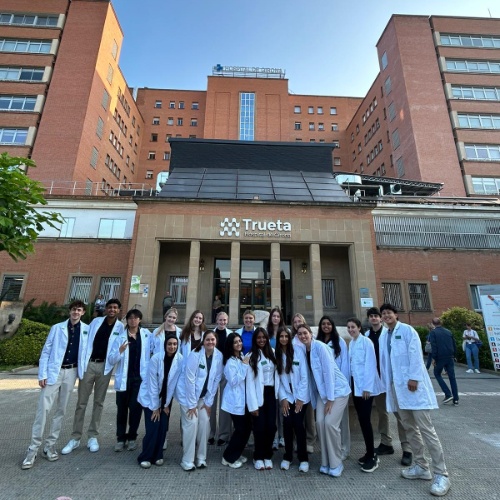
Monika Torkos (second row, fifth from left) with her program cohort in front of Trueta Hospital in Barcelona, Spain.
Those connections were not reserved solely for colleagues. Physicians welcomed MSU students with the same warmth, often checking in on their comfort and taking time to get to know them personally.
“They would always be asking, is there anything we can further explain? Is there anything I can get for you to eat? Do you want some water?” Torkos said. “Additionally, they’d ask about our lives back in America.”
During a full day shadowing a pediatric cardiologist, Torkos experienced that hospitality firsthand. Despite language barriers between Spanish and Catalan, the physician worked intentionally to ensure Torkos could follow along when she was working with her patients.
“She fully asked her patients coming in if they could try to speak more Spanish so that I could understand, since I can speak Spanish,” she said.
Clinical access was equally impactful. While rotating through general surgery, she was able to observe multiple knee reconstruction surgeries and recalled how surgeons actively included students during their procedures.
“One of the general surgeons came over next to us and started asking us how we were doing, what we understood,” she said. “It was just amazing to have that kind of interpersonal experience, even in the middle of a surgery.”
At one point, surgeons even invited students closer to the operating table so they could better understand what was happening, taking moments during the procedure to explain each step.
While Torkos was rotating through various medical specialties, neurology proved to be one that stuck with her the most. She observed brain surgeries and followed physicians through an entire day, from morning rounds to post-op charting.
“It was just so efficient,” she said. “Yet everybody still feels like they’re connected.”
During the day, physicians routinely paused to teach, using visuals and 3D models to explain complex procedures in ways pre-med students could understand.
“[The physicians] really took the time to explain to us because we had never seen anything like it before,” Torkos said.
The Importance of Balance in Healthcare
Beyond technical learning, the Clinical Observation program reshaped Torkos’ ideas about physician well-being and work-life balance. She noticed that the Spanish physicians openly prioritized life outside the hospital while still delivering high-quality care.
“They were always talking about family, hobbies, their plans for the weekend,” she said. “Being able to have their own hobbies and a life outside of medicine.”
That balance was deeply meaningful for Torkos, who admitted that concerns about burnout once made her reconsider medicine altogether.
“It almost deterred me from medicine because I didn’t see the lifestyle the healthcare staff in Barcelona talked about as realistic,” she said. “But seeing it firsthand made me realize it actually is possible.”
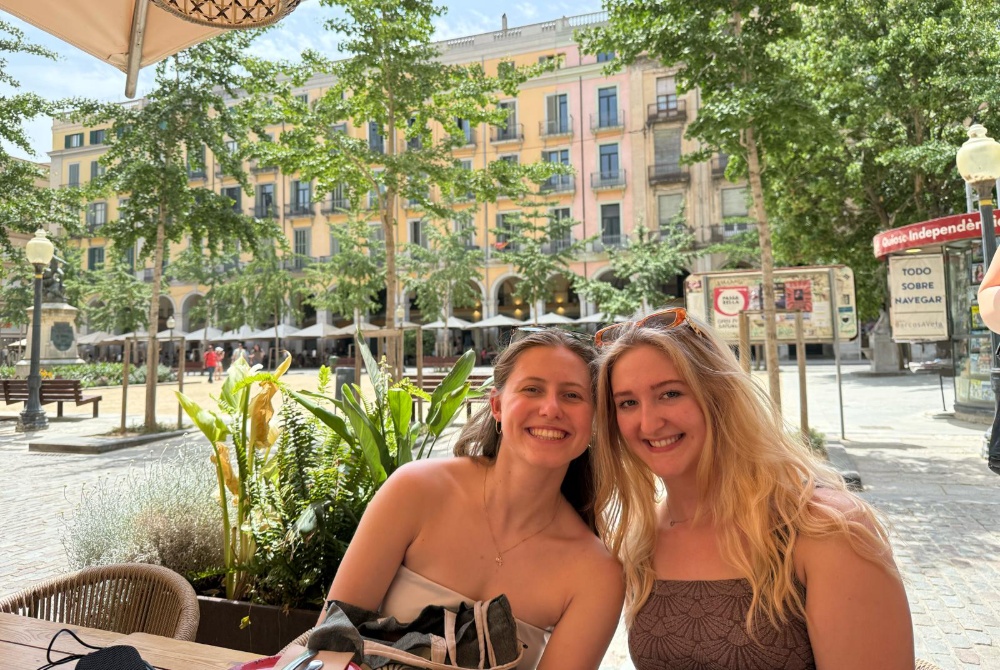
Monika Torkos (left) dining with her program roommate in Barcelona.
As she prepares to apply to medical school this cycle, Torkos says the experience in Spain strengthened her confidence and helped prepare her for her future career goals.
“Something that is extremely valued and searched for in medical schools applicants is that cultural competency.”
The experience also reinforced the kind of physician she hopes to become.
“I want to be able to build those personal relationships with my future patients so that I can better understand them and their lives,” Torkos said. “Then being able to give them the best care that actually correlates to that and is best suited for their lifestyle.”
A Positive and Lasting Impact
For students unsure whether education abroad fits into a demanding pre-med schedule, Torkos believes the value outweighs those concerns.
“Being in that setting and experiencing it yourself is a completely surreal experience. It just opens your mind to so many new mindsets and contexts,” she said.
Looking back, Spain offered more than clinical exposure. It gave Torkos a clearer vision of what medicine can be when empathy, culture and connection are placed at the center of care.
“[The program] was an amazing experience where cultural competency really comes to light.”