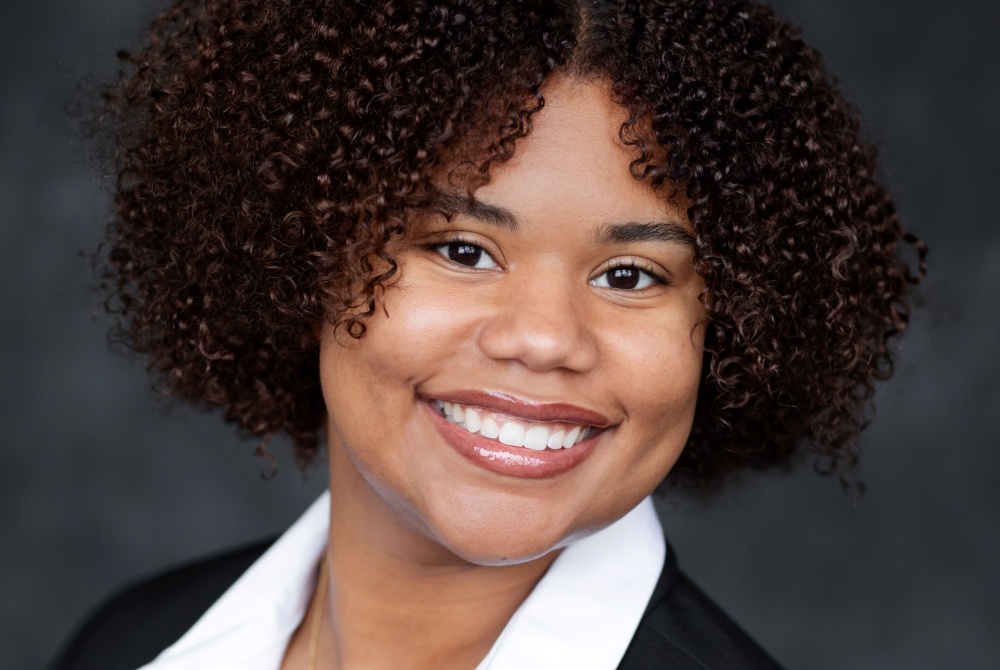
Ta'Sheena Williams serves as Policy Director for the Michigan Council for Maternal and Child Health, where she leads the organization's policy efforts. In this role, she collaborates closely with parent leaders, statewide coalitions, advocates, health care providers, and state agencies to help shape policy priorities and advance reforms related to maternal and infant health, Medicaid, and early childhood systems.
Before stepping into this leadership role, Williams earned her Master of Science in Global Health from Michigan State University's Global Health Studies in 2022. She credits the program with providing valuable knowledge and perspectives that continue to inform and strengthen her work today.
Global Health Studies (GHS) recently caught up with Williams to discuss her experience in the MS in Global Health program and how it has helped prepare her for a career dedicated to improving the health and well-being of mothers, infants, and children.
GHS: When you were initially looking for post-graduate education opportunities, what made the Master of Science in Global Health stand out to you? What made you decide to pursue the degree?
Williams: The Master of Science in Global Health stood out to me because I was interested in learning more about public health but wanted to think about it in a global context. During my undergraduate degree at MSU, I had the opportunity to study abroad and participate in a service-learning experience with Global Brigades, which really piqued my interest in public health and the ways that health is influenced by social, economic, and environmental factors. At the time, I was interested in both medicine and public health, so the Global Health master’s program felt like a natural fit. I also appreciated that it allowed me to explore health beyond the clinical setting and think more broadly about the systems and circumstances that influence people’s health.
GHS: What goals or learning experiences were you hoping to accomplish by completing the master’s program?
Williams: When I entered the program, I wanted to develop a stronger foundation in public health and better understand the factors that influence health outcomes across different populations and settings. I hoped the program would give me opportunities to explore different aspects of global and public health and better understand how research, programs, and systems can work together to improve health outcomes.
GHS: What kinds of skills or knowledge did you gather from the program that have stuck with you?
Williams: One of the things that has stuck with me most is the importance of looking beyond an individual health outcome and considering the larger systems and circumstances that shape it. The program helped me think about health through a broader lens and recognize how factors such as policy, economics, the environment, culture, and access to resources can influence health outcomes. I also had the privilege of experiencing the program during the 2021-2022 academic year, when the COVID pandemic was unfolding, which added another layer of learning and perspective to the program. That perspective has continued to be valuable in my career. My work now focuses on maternal and child health policy, and I often find myself thinking about how policies and systems ultimately affect people’s ability to access care and achieve positive outcomes. I also continue to use the research, critical thinking, and communication skills I developed during graduate school.
GHS: Why, in your opinion, do you think understanding global health is important?
Williams: Understanding global health is important because it impacts everyone. Health outcomes are shaped by much more than what happens in a doctor’s office or hospital. Health outcomes are shaped by social conditions, public policy, economics, the environment, and access to resources. Looking at health from a global perspective helps us recognize those connections and understand that many of the challenges we see in our communities are part of larger systems and trends. I also think that global health encourages us to learn from different communities and approaches rather than assuming that there is one solution to every health challenge.
GHS: If you could say one thing to a potential student who’s thinking about joining the program, what would you say to them?
Williams: I would encourage them to take advantage of the opportunity to explore. Be open to learning about different topics, perspectives, and approaches to health. The program has a wealth of knowledge and experts that you can learn from and engage with throughout the program.
Ready to Explore?
Global Health Studies' Master of Science in Global Health gives you the skills and tools to not only learn global healthcare methods, but also understand how current world structures, systems, and policies impact how health leaders around the world work together. Ta'Sheena Williams uses her knowledge to see how local health policies and systems impact maternal and child health programs. Discover your potential and apply today.